Friday, November 18, 2011

Field Excursion #11: Parliament couldn’t shut us out foreve


        Yesterday the day we had all marked on our calendars finally arrived- we got to go to the Hungarian Parliament. The building is one of a kind and it is one of the main attractions of the city, so I and the rest of the gang were exited to finally get a chance to see the inside of the building. We had to clear several security checkpoints but luckily all of us checked out (even Nellie and Sara who both are in this country illegally), and we entered the building. The building was just as impressive from the inside as it is from the outside, and it was truly a one of a kind experience. Although I didn’t fulfill my lifelong dream of meeting Hungarian Prime Minister Victor Orban, there are luckily still a few weeks left in the trip so I’m holding my breath!
                           I'm not giving up Victor! I'm going to meet you before I leave!


             The inside of the building was incredible. Every inch of the interior was carefully designed and there wasn’t one part of the building that wasn’t breathtaking. The windows were hand-stained, the pillars holding up the building were made from hand-carved granite, and the ceilings were painted with artwork depicting significant points in Hungarian history. We were taken on tour from an amiable Hungarian woman who explained to us the ins and outs of the building, and gave us a sense of the history and importance of the building. She explained how the height of the building was 96 meters, and that the number of steps leading to the rotunda was 96. This was done to commemorate the founding of Hungary by Arpad, the leader of the Magyars, in the year 896.
                                                            The Hungairan Parliament


      After we walked up the exhausting 96 steps we reached the rotunda, which is located inside the dome of the building. In the center of the Rotunda was the Hungarian Holy Crown, which is one of the most famous symbols in all of Hungary. Things such as bridges, streetlights, and even subways in Budapest are adorned with a picture of the crown. The crown was first worn by the founder of the Hungary and the first King of Hungary St. Stephen, who was crowned in the early parts of the eleventh century. No King was considered legitimate unless they were crowned with the holy crown, and it remained a fixture of Hungarian royalty and power for the better part of one thousand years. During the turmoil of the twentieth century there no longer Hungarian kings, and the crown was hidden during various hardships to prevent and possible damages. When the communist regime fell in 1989, the crown was once again brought back to Parliament as a symbol of Hungarian nationalism. For many it is a source of great admiration and honor to see the crown, yet others (such as Professor Lasslo Varadi), feel it is wrong to have a crown as the focal point of a building that houses a democratic government.
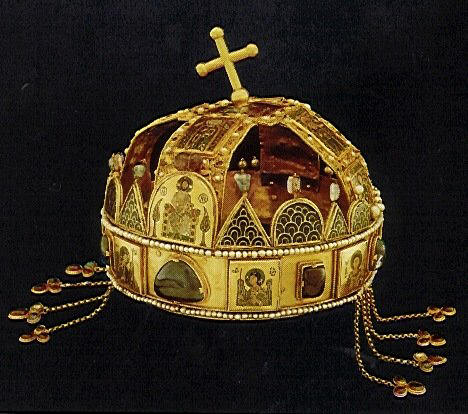
                                    The Hungarian Holy Crown looking prettay prettay prettay good

         After viewing the crown we were given the opportunity to sit on a Parliamentary session in one the chambers of the building, which was special for me because it was the first time I had ever seen “government in action”. Although the session was in Hungarian, it was still really interesting and a cool experience. Overall, I really enjoyed Parliament; it was clearly one of those moments that reminded me how lucky I am to be studying abroad in Europe!

Friday, November 11, 2011

Field Excursion #10: There is a Difference between ILEA and IKEA!


       This week the gang and took a trip to the International Law Enforcement Academy (ILEA) in Budapest. It was another interesting experience, and it was a chance to learn how different countries cooperate to coordinate training to help make the world a safer place. The Academy was located on the Buda side of the city, and its brick façade and green courtyards reminded me of a small University in New England. Upon entry we were met with another amiable bald man (coincidence- I think not!), Mr. Tom Stocking, who is the deputy director of the Budapest Academy. We were given a tour of the facilities and then were given an opportunity to sit down with several prominent members of the ILEA staff to learn the ins and outs of the organization. We also were given free pens, so overall it was a productive and educational day!
                                            Who doesn't love free pens?!?

       The academy itself was quite unique and unlike anything I had ever been too before. They take in students from all over Central and Eastern Europe, and they have to have the proper facilities in place to ensure every participant can make the most out of their experience. Mr. Stocking took us on a tour of the campus and showed us where the future policemen and women eat, live, learn, train, and work-out. He talked about how it was important to make them all feel as comfortable as possible to ensure high-morale throughout the campus. Towards the end of the tour he took us to a “simulation room”, where the students practice real-life police work scenarios. We stood on a catwalk overlooking the simulation room, and we had a bird’s eye view of all the different rooms and scenarios that the students must go through during their different training exercises. Mr. Stocking said that this is the most exciting part of the training for the cadets and that they enjoy it much more than they enjoy their classes (hard to believe). After, we were taken to one of the Academy’s classrooms, where the educational portion of our visit began.
                                                           This is the logo for ILEA!
                                                                
        In the classroom we listened to presentations from several important members of the ILEA staff. First up to bat was Mr. Stocking, who told us about his personal background and the details of what actually goes on at the academy. Stocking is an employee of the US State Department, and he and his superiors are on a three year assignment at the academy. In the 1990’s he worked as part of the security details for Clinton’s Secretaries of State Warren Christopher and Madeline Albright. He explained how the State Department staffs security in embassies all over the world, while also working on international crime such as passport and visa fraud cases. When he was done speaking one of his colleagues known as “Tibby” rocked the mic and explained to us his role in the organization. Tibby is a Hungarian born employee of the State Department who has been working with them since the early 1990’s. He grew up in Communist Hungary and explained to us the many turmoils and difficulties of his parent’s generation. He said that this turmoil in Hungary and its surrounding countries lead to a culture that desperately needed a strong and capable police network. He said that in some countries the phrase “A wife unbeaten is like a home unkept” was not the exception, but rather commonplace. Organizations like ILEA were desperately needed in order to train men and women who can try to change the culture and enforce the law. This goes to the show the importance of having capable and well-trained civil officers if one desires to live in a safe environment. We often complain about the police and perhaps it is sometimes deserved, but we are extremely lucky to live in a place where policemen and women are able and willing to uphold the rule of law.
                                    Don't want to forget the work of the police dogs as well!

          Towards the end of the presentation the Director of the Academy Mr. John Terpinas spoke with us briefly about his background and role in the organization. Terpinas is a United States citizen and employee of the FBI who like Mr. Stocking, is on a three-year assignment. He was an extremely cordial and intelligent character who just so happens to come from Greek ancestry (hmmmmm). We talked at length on how to get involved in his line of work and what federal agencies look for in perspective candidates. Although I personally don’t desire a career in the ol’ FBI I did feel that Mr. Terpinas did a very good job of explaining the perks of his profession and the important tasks the agency carries out. He also issued the shocking revelation that if one wants to work for the Federal Bureau of Investigation it would be wise for them to stay out of trouble. I left the presentation with a renewed sense of the importance America can play in the rest of the world when we put our best foot forward. Agencies such as ILEA promote good and undoubtedly make the world a better place. Some may disagree, but I firmly believe that America has a moral obligation to help improve the quality of life of people who are not as privileged as us. Obviously one could take this as justification for actions such as the invasion of Iraq but not everything America does will work out in its favor. Mr. Stocking stressed to us the importance of America’s role in the world, and he pleaded with us to make sure that international agencies and other foreign services are always part of the political discourse (perhaps instead of talking about who Hermann Cain groped this week and if Mitt Romney is actually half-robot). I agree thoroughly with him and I hope that our generation will continue to spread America’s (good) influence abroad through great organizations such as ILEA.
          
   This is the song "American Tune" by Paul Simon. It is his analysis of America and where is was heading in the 1970's. He expressed sorrow over its failures (Vietnam), but optimism that the US could still remain a force of good in the world.

Saturday, November 5, 2011

Field Excursion #9: The JSPB Boys and Girls are brought in to solve Europe’s Problems

          This week the gang and I had the privilege to sit down with Mr. Andras Bath, a prominent member of the European Commission. Mr. Bath was born and raised in Hungary, and now works in Brussels at the EU’s headquarters. Out of all of the guest lecturers we have met with this semester, I felt Mr. Bath was the best one. He was charismatic, amiable, intelligent, and most importantly genuine. Mr. Bath did not shy away from the “hardball” questions that the JSBP kids are known for, and he answered all of our questions with an honesty that one seldom sees from a high-ranking person talking to a group of twenty-something’s. One of the reasons I think this may be is because he was a bald man, and as Larry David would say, “Bald men are just more trustworthy”. On the other hand I think he was just a good guy who wanted to help us better understand what is going on in Europe; and he realized the best way to do so was to spell out the EU’s strengths and weaknesses as accurately and thoughtfully as possible.
              I wanted to put a video clip of Larry David, but I couldn't find any that weren't vulgar.
                                                        This will have to do.                    


           During the first part of the lecture Mr. Bath explained to us what exactly the EU is and why it was formed in the first place. It is similar to the UN in the sense that it is one organized body made up of many “member states” that have power within the organization based on size and economic power. However, it is different from the UN because all the countries involved are closely connected socially, politically, and (perhaps most importantly) economically. He explained about the desire in Europe throughout the twentieth century to create a common ground for all the countries to work together to make Europe as prosperous as possible. One point that he made which I found particularly interesting and had not heard before was the fact that since the creation of the EU there has been no wars between member states. This is extremely noteworthy because of the history of violent conflict in Europe that dates back centuries. On a global scale the EU gives Europe a chance to compete economically, which none of the member states could do on their own because of their small size. Together, they make a big enough economy to compete on a world scale. This seems like a nice idea in principle, but as Mr. Bath soon explained things there are some extreme flaws in the economic makeup of the EU.
      
                  This is a map of the EU and its member states with their respective flags.

           The talk with Mr. Bath couldn’t have come at a more appropriate time. One cannot turn on the news right now without being bombarded by a plethora of stories about the EU-euro crisis and Greece’s glaring economic woes. President Obama is currently at the G-20 summit in France trying to help “save” Europe, and the whole world’s attention is focused on the continent that we currently call home. As I said earlier Mr. Bath is employed in an organization that is part of the EU, and he stressed its importance in certain realms throughout his talk. Yet what surprised me was that he was more than willing to be critical of the economic policies of the EU that have lead to this disaster. He explained to us that one of the biggest problems the EU has had is that there is no strong federal regulating body to oversee (and punish if necessary) the ins and outs of every member state’s economies. The United States is similar to the EU in the sense it is large and full of extremely diverse geographic and economic regions. However, the difference is that the US federal government has the power to regulate industry, trade, commerce, taxes and many other economic tools in order to make sure the discrepancies between states does not become so bad it can bring the entire country’s economy to a halt (ex.-Greece).  This is not to say that the US doesn’t have its own (glaring) economic problems, but rather that it does have ways to regulate the economy from a federal level.
            Future US President Rick Perry hates the federal government and its regulatory policies, but he should realize there are good reasons to have a strong federal body to regulate commerce. He should also realize that one shouldn't insult something that they are campaigning to be the head of.


            Since the EU does not have the proper oversight institutions in place, they were in many ways doomed from the start. Mr. Bath claimed that part of the reason Greece is in such shambles is because they sent in false documents and numbers in order to gain acceptance in the EU. He claimed they were not strong enough to be emitted into the EU to begin with, and therefore the mess we see today was a ticking time bomb. The easy thing to do would be to put the blame soley on the Greeks (although I do agree they are largely to blame), but we must give the EU some blame for not being strong enough to catch their bluff! If the EU had any competent oversight agency they would have been able to look at Greece’s numbers and saw the discrepancies between the truth and what the Greeks reported. Instead the EU essentially “took Greece’s word” and just assumed that all countries are good and honest and would never embellish the truth to gain entry into their Union (somewhat idiotic if you ask me). Mr. Bath pointed out that one of the reasons this happened was that the Euro zone idea was created too quickly and essentially rushed into existence. The EU was so eager to create the inter-continental currency that they put forth a product that still had a lot of kinks in it. Obviously economies are complex and difficult to predict, but a little more time and foresight may have prevented the mess we see before us today.
                  While people are blaming Greece for all the world's problems, they seem to forget the many Greeks that have made the world a better place. Imagine a world without Socrates? How about one without 14-time major champion Pete Sampras? How about one without Yanni, who is essentially the Elvis Presley of our generation? And who doesn't love Jennifer Aniston and my namesake, Alexander the Great?